Languages of Azad Kashmir: A Complete Guide
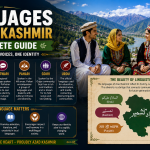
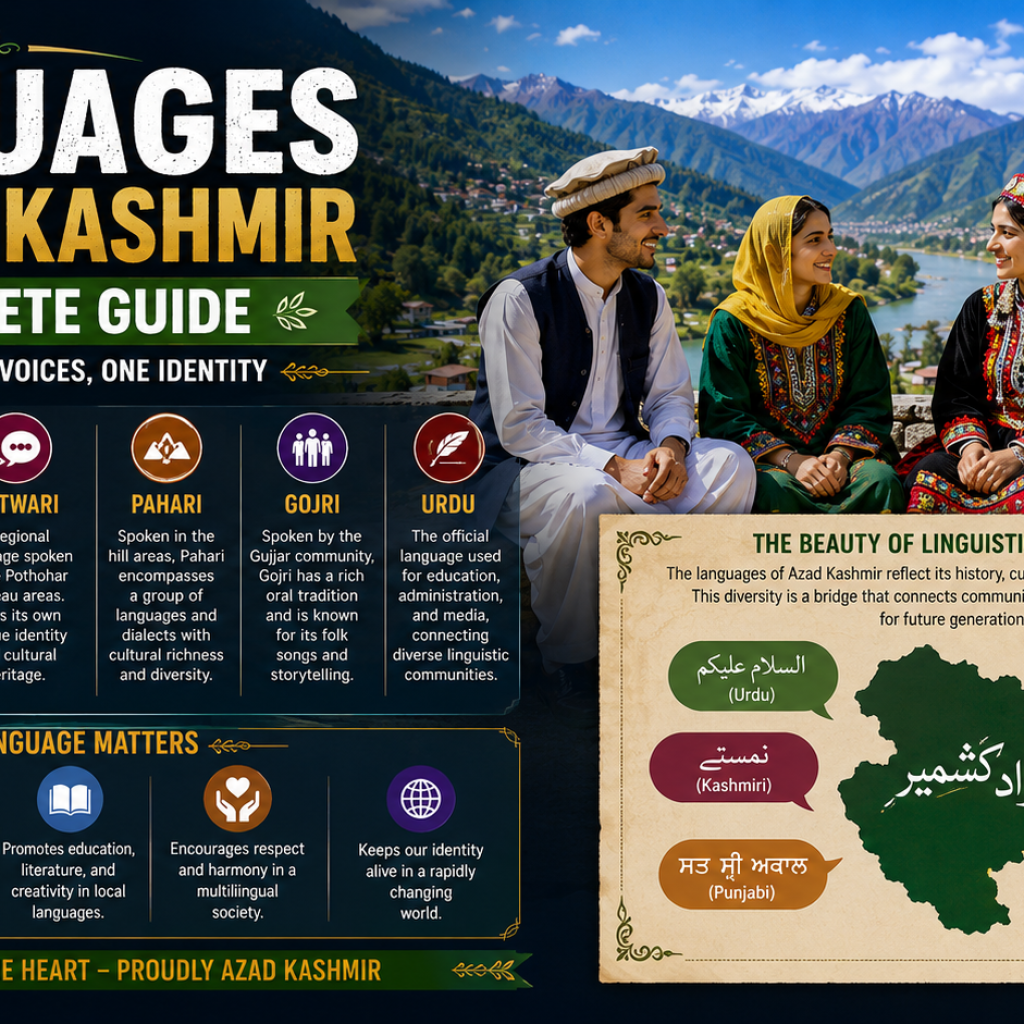
Languages are a living treasure of the culture of Azad Kashmir. Many languages fill the villages, valleys and towns of the land. Pahari serves as the common speech across most of the area. Gojri, Kashmiri and Hindko add their own rich voices. Urdu ties the people together in school and office. This guide covers the languages of Azad Kashmir for the curious traveller. It explains the languages, Pahari, its dialects, Gojri, Kashmiri and identity.
This guide offers a general overview. Details and figures vary between sources.
Quick answer: The region of Azad Kashmir boasts a number of languages, which makes its linguistic profile quite unique. The most common language in this region is Pahari, also known as Pahari-Pothwari, the lingua franca in most parts of the area. Gojri is the language of the Gujjar and Bakarwal herdsmen, whereas the ethnic Kashmiris from the north speak Kashmiri. Hindko is another language spoken in certain areas, and Urdu is the official language in addition to English. The sense of Kashmiri identity unites the speakers of this language, and Pahari is popular with the diaspora in Britain.
A land of many languages
A land of many languages azad Kashmir brims with speech. Many languages fill the air. Each carries its own culture. So variety marks the land.
A rich mix marks the area. Several languages share the hills. Each holds its own heritage. So language runs deep.
A common speech marks the people. Pahari links most villages. Other languages fill the rest. So one language ties the land.
A shared language marks the schools. Urdu serves as the link. Office and class both use it. So Urdu binds the people.
Pahari the common language
Pahari the common language, unites most of the land. It fills the daily life. Most people speak it at home. So the language ties the area.
A wide speech marks Pahari. Most people speak it daily. It links village to village. So the language serves as a bridge.
An Indo Aryan root marks the language. It belongs to a wider family. Punjabi and Lahnda run near it. So old roots shape the speech.
A large body marks its speakers. Millions use it across the land. Many more speak it abroad. So the language reaches far.
Dialects of Pahari
Dialects of Pahari vary from valley to valley. Each area shapes its speech. All remain Pahari at heart. So the language shifts with place.
A northern form marks Muzaffarabad. Its speech blends with Hindko. Kashmiri colours it too. So the dialect takes local hue.
A central form marks Poonch. Bagh and Sudhanoti share it. Linguists call it the core. So the dialect anchors the rest.
A southern form marks Mirpur. Pothwari shapes the speech. Kotli speaks its own blend. So the dialects spread wide.
Gojri of the herders
Gojri of the herders carries a pastoral heritage. Gujjar families speak it. Bakarwals share the language. So the language roams the hills.
A herder speech marks Gojri. Gujjars use it in the hills. Bakarwals carry it too. So the language follows the flocks.
A wide reach marks the language. It spreads across South Asia. Many hill peoples speak it. So Gojri travels far.
A living language marks the Gujjars. They keep it in the home. Songs and tales use it. So the speech endures strong.
Kashmiri in the north
The north Kashmiri has an age-old tradition. The ethnic Kashmiris speak this language. This language is kept alive in northern valleys. Hence, the language stays alive there.
The north Kashmiri language is distinguished by its language family. Muzaffarabad has many speakers. Neelum and Hattian regions have even more. Thus, the north keeps this speech alive.
The unique origin distinguishes the north Kashmiri language. It is different from the surrounding languages like Pahari. Its phonology distinguishes it from others. Thus, the language sounds different.
A slow change characterizes the language use. The youth prefer speaking Pahari language. The Urdu language also lures them. Thus, the old language needs protection.
Urdu, English and identity
Urdu, English and identity shape the wider picture. Official languages serve the state. A shared pride binds all. So language and identity meet.
An official language marks Urdu. Schools and offices use it. English joins it in the state. So the two serve wide roles.
A strong pride marks the people. A Kashmiri identity unites them. Language differs, yet pride holds. So unity crosses the languages.
A far reach marks the diaspora. Many carry Pahari abroad. Britain holds many speakers. So the language lives overseas.
Frequently asked questions
What languages are spoken in Azad Kashmir? Azad Kashmir is home to several languages, reflecting its varied peoples. Most widely spoken is Pahari also called Pahari Pothwari the common language across most of the area. A pastoral people the Gujjar and Bakarwal herders speak Gojri, while ethnic Kashmiris in the northern districts around Muzaffarabad, Neelum and Hattian, speak Kashmiri. Hindko is spoken in some parts, such as around Garhi Dupatta. Urdu is the official language, used in schools, offices and the media along with English. Small pockets of Pashto and rare local dialects add further variety to the speech of the area.
What is the Pahari language? Pahari also known as Pahari Pothwari is the most widely spoken language of Azad Kashmir, serving as the common language in daily life across most of the area. It belongs to the Indo Aryan family, within the wider Lahnda or Pahari Pothwari group, related to neighbouring languages such as Punjabi. According to the 1998 census, it was spoken by around 3.5 million people, with several local dialects. Historically written in the Shahmukhi script, Pahari is a rich spoken language of songs, poetry and everyday life. It also thrives among the large overseas community in Britain.
What are the main dialects of Pahari? Pahari in Azad Kashmir has several local dialects that vary from area to area, though all remain closely related. A northern form the Muzaffarabadi dialect, spoken around Muzaffarabad, shows the influence of Hindko and Kashmiri. A core form the Poonch dialect also called Poonchi is spoken in Poonch, Bagh, Haveli and Sudhanoti. Most linguists regard it as the central variety. A blended form the Kotli dialect, spoken around Kotli and Nakyal, shows the influence of Gojri and Pothwari. In the south the Mirpuri dialect, spoken in Mirpur and Bhimber, blends closely with Pothwari, well known through the diaspora in Britain.
Is the Kashmiri language still spoken in Azad Kashmir? Yes the Kashmiri language is still spoken in Azad Kashmir, though mainly in the northern districts and by a minority of the population. Ethnic Kashmiris speak it in pockets around Muzaffarabad, Neelum and Hattian, with smaller communities in Haveli and Bagh. A related form the Kashmiri spoken here is distinct from, though close to, that of the wider Kashmir Valley. In recent times, however the use of Kashmiri has been slowly declining as younger speakers increasingly adopt the more widely spoken Pahari Pothwari, Hindko or Urdu. Efforts to record and value the language help keep this ancient language alive.
What language do people use for education and official work? In Azad Kashmir, Urdu is the main language of education, government and official work as it is across much of Pakistan. Schools teach largely in Urdu. It also runs through offices, courts, newspapers and broadcasting, serving as a shared link between speakers of different mother languages. English is also an official language and is used in higher education administration and some formal settings. Meanwhile, everyday conversation at home and in the community usually takes place in Pahari, Gojri or Kashmiri, so most people grow up comfortably using more than one language.
The living voices of Kashmir
Languages are the living voices of the culture of Azad Kashmir. Many languages fill the villages, valleys and towns of the land. Pahari serves as the common speech across most of the area. Gojri, Kashmiri and Hindko add their own rich voices. Urdu ties the people together in school and office. Few lands hold so rich a mix of living languages as this one.
You may come for the culture the poetry or the speech. These living voices reward the curious traveller. You can hear Pahari spoken warmly across the green valleys. You can catch Gojri among the herders on the high meadows. You can listen for Kashmiri in the northern towns and villages. Come to know the languages of Azad Kashmir and their rich heritage. These are the living voices of Kashmir.