Mazar-e-Quaid Karachi: A Complete Guide to the National Mausoleum
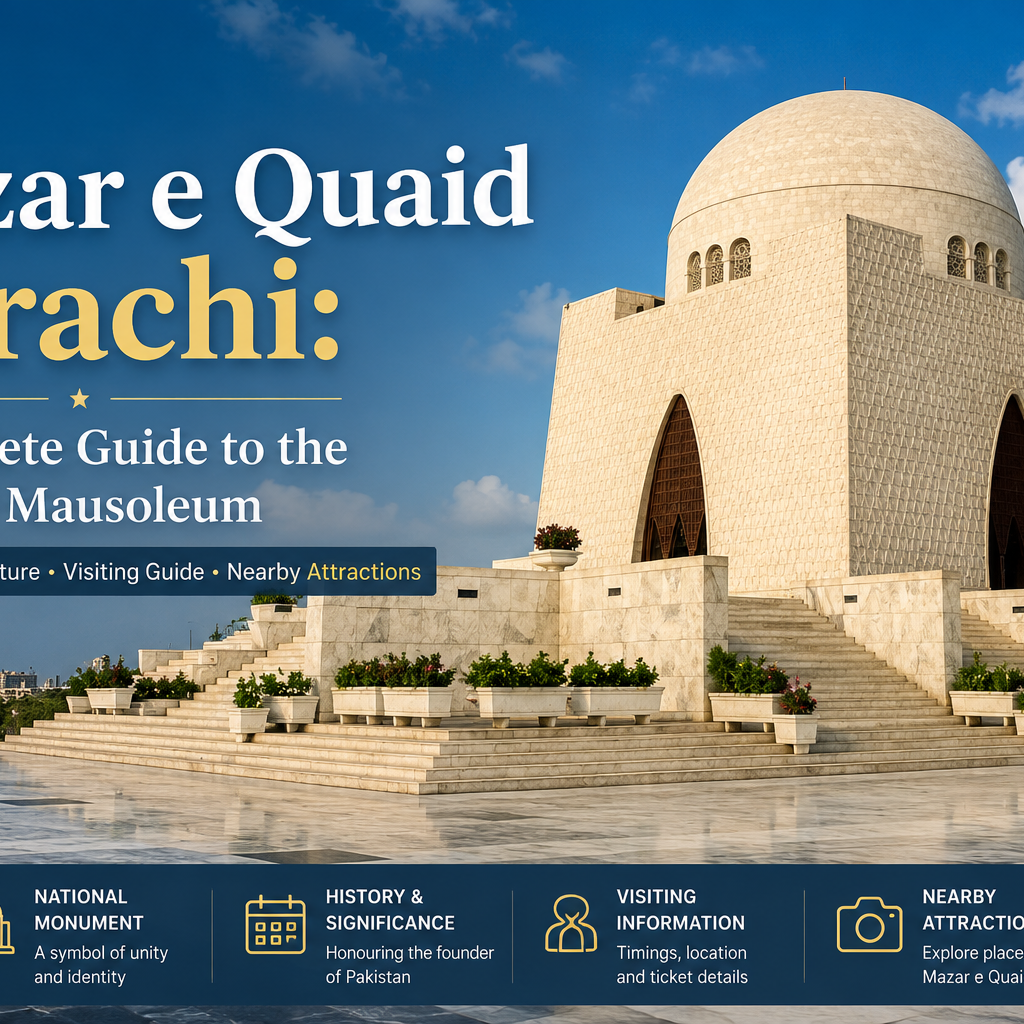
Mazar e Quaid is the most important national monument of Karachi. It is located in the Jamshed Quarters area in the heart of the city, at the end of the Muhammad Ali Jinnah Road. Mazar e Quaid is the final resting place of Muhammad Ali Jinnah who founded the country. It is known for its striking white marble structure its neo Mughal gardens and its ceremonial guard. It was designed by the architect Yahya Merchant and completed in 1971. For anyone getting to know Karachi, Mazar e Quaid is the defining landmark of the city and a place of deep national pride.
This guide explains what Mazar e Quaid is its history its architecture and how to visit.
Mazar e Quaid
Mazar e Quaid is the national mausoleum of the country, located in central Karachi, also known as the Jinnah Mausoleum or the Quaid e Azam Mazar. It is the final resting place of Muhammad Ali Jinnah who is revered as the Quaid e Azam, meaning the Great Leader. He founded the country and served as its first Governor General. The name Mazar e Quaid translates from Urdu as the Tomb of the Leader.
Mazar e Quaid is a grand white marble monument built on a raised platform in a park of around 53 hectares, laid out in a neo Mughal style with terraces, lawns and fountains. It is regarded as the largest mausoleum in the country and one of the most recognised landmarks of the city. The complex also holds the tombs of other national figures.
Mazar e Quaid is far more than a tomb. It is an iconic symbol of Karachi and one of the most visited sites in the city, drawing citizens, students, dignitaries and tourists from across the country and beyond. It serves as the focal point for national ceremonies. Its change of guard ritual gives it a solemn, patriotic character.
Quick answer: Mazar e Quaid is the national mausoleum of the country, located in the Jamshed Quarters area of central Karachi. It is the final resting place of Muhammad Ali Jinnah, the founder of the country. Designed by the architect Yahya Merchant and completed in 1971 it is a white marble monument set in a 53 hectare neo Mughal park.
Muhammad Ali Jinnah and the mausoleum
The story of Mazar e Quaid begins with Muhammad Ali Jinnah. He led the struggle for the creation of the country and became its first Governor General in 1947. He died in September 1948, little more than a year after independence. His resting place was first marked simply by a large white marble slab raised on a plinth. This modest early grave stood before the grand mausoleum was built.
The path to a fitting memorial was long and much debated. The Quaid e Azam Memorial Fund was established in 1949 to create a suitable monument. Several proposals were considered and set aside over the years. An international competition held in 1957 was won by a British architect, though the design was later vetoed by Fatima Jinnah, the sister of the Quaid. She then assumed control of the fund and commissioned the architect Yahya Merchant, a Bombay based architect who was a personal friend of Jinnah.
The mausoleum finally took shape over a decade. President Ayub Khan laid the foundation stone on 31 July 1960. The monument opened in 1971. The surrounding gardens were completed later, in December 2000. The design of Merchant was praised for drawing on the spirit of tradition while meeting the demands of its own time. It has been described as a traditional monument of a modernist period.
Architecture and design
Mazar e Quaid is celebrated for its bold, elegant architecture. The mausoleum is a cuboid structure crowned with a dome, clad entirely in white marble. The building has a square footprint of around 75 by 75 metres and rises to a height of about 43 metres, set on a raised platform above the city. It appears simple from a distance yet reveals rich material and fine detailing when viewed closely.
The design is rich in national symbolism: the white marble is said to represent the purity and simplicity of Jinnah while the disciplined cuboid form reflects his character. The four arched entrances feature fine copper latticework. The whole monument was built with materials sourced from the local area. This blend of eastern tradition and modernist form gives the mausoleum its distinctive presence.
Mazar e Quaid is set in gardens that pay tribute to the Mughal heritage of the region, laid out with terraces, lawns and around fifteen fountains in a neo Mughal style. At night, spotlights project onto the white marble, so the glowing monument can be seen from a distance. The site was placed so that the main roads of the city converge towards it.
Inside the mausoleum
Mazar e Quaid holds the tombs of several national figures alongside that of the Quaid. The main sarcophagus of Muhammad Ali Jinnah lies at the centre of the marble hall, beneath the dome, made of white marble and raised on a triple base. This central tomb is the focus of the mausoleum and of the respect paid by visitors.
The complex is the resting place of other leaders too. The tomb of Fatima Jinnah lies within the hall, marked by a floral ornamentation at its base. She was the sister of the Quaid and is revered as the Mother of the Nation. The tombs of Liaquat Ali Khan and Nurul Amin who were the first and eighth prime ministers of the country are also here along with that of Sardar Abdur Rab Nishtar, a leading figure of the Muslim League.
Mazar e Quaid also houses a museum of personal relics. A chamber at the site displays personal belongings of Muhammad Ali Jinnah, including his footwear, his spoons and one of his cars, offering a closer sense of the life of the founder. The dignity of the marble hall and the ceremonial guard give the interior a solemn atmosphere.
Ceremonies and national days
Mazar e Quaid is the setting for the most important national ceremonies of the country. Official and military ceremonies take place on its grounds on special occasions. Foreign dignitaries often visit during official trips, placing the mausoleum at the heart of national life.
The mausoleum is central to the national days. Ceremonies are held here on Pakistan Day on 23 March, on Independence Day on 14 August and on the birth anniversary of the Quaid on 25 December along with his death anniversary on 11 September. Government leaders and military officials pay tribute to the founder on these days with parades and floral tributes.
The change of guard ceremony is a highlight for visitors. A ceremonial guard, drawn from the armed forces, keeps watch at the tomb and is changed in a formal ritual through the day, adding to the dignity of the site. This blend of daily ritual and national ceremony gives Mazar e Quaid its living, solemn character.
Visiting Mazar e Quaid
Mazar e Quaid is one of the most rewarding places to visit in Karachi for history and national heritage, offering a grand monument, a peaceful park and a sense of the story of the country in one place. It suits families, students, history enthusiasts and visitors from abroad. A visit combines the mausoleum, the relic museum and a walk through the gardens.
Mazar e Quaid is open to the public seven days a week, generally through the day, though the hours may vary on national holidays. There is no entry fee to the grounds. Modest, respectful dress is expected, as this is a place of national reverence. Visitors should treat the site with the dignity it holds. The cooler months from around November to March offer the most comfortable time to visit.
Mazar e Quaid is reached easily as it is located in the heart of the city, near the Numaish Chowrangi on the Muhammad Ali Jinnah Road. It is accessible by car, taxi, rickshaw and ride hailing service. The main roads of the city converge towards it. The mausoleum is best explored on foot. The evenings are pleasant when the monument is lit. A visit combines well with the nearby central areas of the city.
Places near Mazar e Quaid
Mazar e Quaid is located within reach of many landmarks and useful places in central Karachi. The Numaish Chowrangi lies close by on the Muhammad Ali Jinnah Road. The Nishtar Park is nearby. The TDF Ghar which is a restored heritage house run by the Dawood Foundation is close to the mausoleum in the Jamshed Quarters area.
The Sindhi Muslim Society with its food street and eateries is a short distance away. The Saddar area with the Empress Market and colonial era landmarks is nearby. The Frere Hall and the central business district are within reach. The Tipu Sultan Road and the Shaheed e Millat Road connect the area to the wider city.
Frequently asked questions
Where is Mazar e Quaid located? Mazar e Quaid is located in the Jamshed Quarters area of central Karachi, near the Numaish Chowrangi at the end of the Muhammad Ali Jinnah Road. It is close to the Nishtar Park, the TDF Ghar and the Sindhi Muslim Society. The main roads of the city converge towards it.
Who is buried at Mazar e Quaid? Mazar e Quaid is the resting place of Muhammad Ali Jinnah, the founder of the country. The complex also holds the tombs of his sister Fatima Jinnah, the first prime minister Liaquat Ali Khan, the eighth prime minister Nurul Amin and the Muslim League leader Sardar Abdur Rab Nishtar.
Who designed Mazar e Quaid? Mazar e Quaid was designed by the architect Yahya Merchant, a Bombay based architect who was a personal friend of Muhammad Ali Jinnah. He was commissioned by Fatima Jinnah after an earlier competition design was set aside. Construction began in 1960 and the mausoleum was completed in 1971.
What is the architecture of Mazar e Quaid like? Mazar e Quaid is a cuboid structure crowned with a dome, clad entirely in white marble with a footprint of around 75 by 75 metres and a height of about 43 metres. It has four arched entrances with copper latticework and is set on a raised platform in a neo Mughal park of terraces and fountains.
What are the opening hours and entry fee? Mazar e Quaid is open to the public seven days a week, generally through the day with no entry fee to the grounds. The hours may vary on national holidays. Modest, respectful dress is expected. The cooler months from around November to March are the most comfortable time to visit.
Mazar e Quaid is the most important national monument of Karachi and a symbol of the founding of the country. Located in the heart of the city and designed by the architect Yahya Merchant it has stood since 1971 as the final resting place of Muhammad Ali Jinnah, the Quaid e Azam. Its striking white marble structure its neo Mughal gardens and its ceremonial guard make Mazar e Quaid a place of deep national pride and one of the most recognised landmarks in the country.
Mazar e Quaid brings together history, architecture and national reverence in one grand monument. Its marble hall holds the tombs of the founder and other national figures its relic museum offers a closer sense of the life of the Quaid. Its gardens provide a peaceful space in the busy city. As the setting for the national ceremonies of the country it remains a living symbol as much as a historic site. Whether you visit Mazar e Quaid to pay tribute, to admire its architecture or to walk through its gardens it remains the defining landmark of Karachi and a lasting memorial to the founder of the country.