Kamran's Baradari Lahore: The Mughal Pavilion on the Ravi
It was built in 1540 by Kamran Mirza, a son of the emperor Babur. For anyone getting to know Lahore, Kamran's Baradari offers a quiet, atmospheric glimpse into the beginnings of the Mughal story of the city.
This guide explains what Kamran's Baradari is, its history, its architecture and how to visit.
Kamran's Baradari
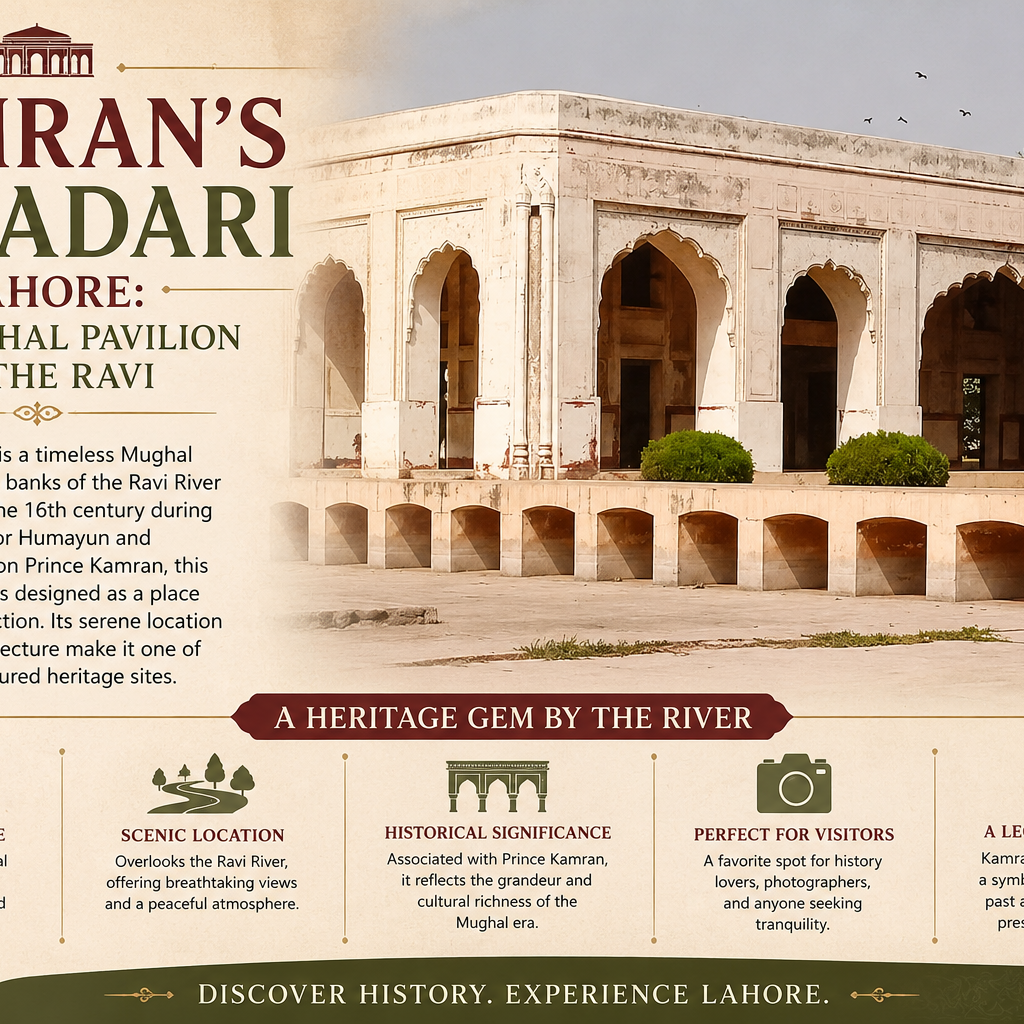
Kamran's Baradari is a historic Mughal summer pavilion located on an island in the River Ravi, near Lahore, also known as the Baradari of Kamran Mirza. It is believed to be the oldest existing Mughal structure in the city, a rare survivor from the very earliest days of Mughal rule in the region. The word baradari means a building with twelve doors, from bara for twelve and dari for doors. The twelve openings were designed to catch the breeze and provide ventilation in the summer heat, making the pavilion a cool summer retreat.
Kamran's Baradari holds a special place among the monuments of the city. It is the only surviving Mughal structure in the Shahdara Bagh area that was not built as a funerary monument, unlike the nearby tombs of Jahangir, Nur Jahan and Asif Khan. It was originally built on the western bank of the River Ravi, overlooking the historic city. Over the centuries the river changed its course and left the pavilion on an island in the middle of the riverbed. This shifting of the river is one of the most remarkable features of its story.
Quick answer: Kamran's Baradari is a Mughal summer pavilion of prince Kamran which is located on an island in the River Ravi. Built in 1540 by Kamran Mirza, a son of the emperor Babur, it is believed to be the oldest surviving Mughal structure in the city. Known for its twelve arched openings, it was once on the riverbank but now lies on an island due to the shifting course of the river.
A prince and his pavilion
The story of Kamran's Baradari begins with a Mughal prince. Kamran Mirza was a son of Babur, the founder of the Mughal Empire, along with being a brother of the second emperor, Humayun. After the death of Babur in 1530, Kamran Mirza seized control of Lahore and the Punjab. He laid out a garden by the River Ravi, in which the baradari was built in 1540. He was a military commander and a patron of the arts, though he is often remembered for his political ambitions.
Kamran Mirza met a harsh end, as was common in the power struggles of the era. When Humayun returned and defeated him, Kamran Mirza was blinded and sent to Mecca to perform the Hajj as punishment. His pavilion outlived him and became his lasting mark on the city. It witnessed further chapters of Mughal history: the emperor Jahangir was camped at the baradari in 1606 when his rebel son, Prince Khusrau, was captured and brought before him. The pavilion remained in use by the Mughal royals until the 18th century.
Building and its design
Kamran's Baradari is a fine example of early Mughal architecture. It is a two storey pavilion built with brick and red sandstone, rectangular in plan with twelve arched entrances, three on each side, along with an open courtyard in the middle. Its design draws on Persian, Central Asian and local architectural traditions. The twelve openings create a fluid relationship between the inside and the outside, allowing cross ventilation in the summer heat. The upper storey has a balcony running around it, offering views of the river and the surroundings.
Kamran's Baradari is known for its decorative details. The existing decorations consist of elaborate stone carvings, flower designs and geometric patterns. White marble is contrasted against the red sandstone in some areas resulting in a material contrast effect. Some scholars believe that some decorative features, like the cusped arches, are more characteristic of the architectural style under the reign of Shah Jahan. Consequently, some speculations have emerged that the existing construction was refurbished by subsequent Mughals. There is an uncertainty about the history of the construction, which makes the story more interesting.
Changing fortunes over the centuries
Kamran's Baradari has passed through many hands and uses over the centuries, reflecting the changing rulers of the city. It served the Mughal royals as a summer retreat and a place of recreation, where they could enjoy the breeze and the performances of musicians and dancers. This role as a pleasure pavilion is central to its early history.
Kamran's Baradari changed use under later rulers. During the reign of the Sikh ruler Ranjit Singh, the pavilion is said to have been used as a jail. After the British annexed the Punjab in 1849, they turned it into a tollhouse for boats crossing the river. The ebb and flow of the river damaged the structure over time, at points severely affecting the upper storey. Serious conservation work was undertaken in the 1990s and again in 2006 by the Lahore Conservation Society. This work restored the pavilion and opened it to the public.
Planning a visit
Kamran's Baradari is one of the more atmospheric heritage sites to visit near Lahore, offering a quiet, intimate glimpse of Mughal architecture away from the grand monuments. It suits history lovers, photographers and anyone seeking a peaceful, offbeat spot. The pavilion is located on an island, so visitors cross the river by rowboat or motorboat from the bank. The boats charge a small fee and may wait to fill up before departing, so there can be a wait. This crossing is part of the experience.
Kamran's Baradari is generally open through the day with a modest entry fee. The reported hours are from around 9:00 in the morning to 5:00 in the evening, though it is best to check the current timings before visiting. Early mornings are quieter and more pleasant. The pavilion is rarely overcrowded. Visitors should note that the condition of the River Ravi around the site can be poor with pollution in places.
Kamran's Baradari is reached easily as it is located in the Shahdara area, a short drive from the Walled City. It is accessible by car, taxi, rickshaw and ride hailing service. The cooler months from around October to March offer the most comfortable time to visit. A visit combines well with the nearby Tomb of Jahangir and the other Mughal sites of Shahdara.
Places near Kamran's Baradari
Kamran's Baradari is located within reach of many landmarks and useful places on the north western edge of Lahore. The Tomb of Jahangir, one of the finest Mughal mausoleums, lies nearby in Shahdara. The Tomb of Nur Jahan and the Tomb of Asif Khan are close by in the same area. The Akbari Sarai is located within the Shahdara complex.
The Walled City with the Lahore Fort and the Badshahi Mosque is a short drive away. The Samadhi of Ranjit Singh and the Gurdwara Dera Sahib are within it. The Minar e Pakistan and the Greater Iqbal Park are within reach. The River Ravi and the Ravi Bridge connect the area to the city.
Frequently asked questions
Where is Kamran's Baradari located? Kamran's Baradari is located on a small island in the River Ravi, in the Shahdara area on the north western edge of Lahore. It is a short drive from the Walled City and near the Mughal tombs of Shahdara, such as the Tomb of Jahangir.
Who built Kamran's Baradari? Kamran's Baradari was built in 1540 by Kamran Mirza, a son of the emperor Babur, the founder of the Mughal Empire. He was a brother of the second emperor, Humayun. Kamran Mirza laid out a garden by the River Ravi in which the pavilion was built.
Why is it called a baradari? The word baradari means a building with twelve doors, from the words bara for twelve and dari for doors. Kamran's Baradari has twelve arched openings, designed to catch the breeze and provide ventilation in the summer heat. This made this pavilion a cool summer retreat.
Why is Kamran's Baradari on an island? Kamran's Baradari was originally built on the western bank of the River Ravi, overlooking the city. Over the centuries, the river changed its course and left the pavilion on an island in the middle of the riverbed. Visitors now reach it by a short boat ride.
How do you get to Kamran's Baradari? Kamran's Baradari is located in the Shahdara area, a short drive from the Walled City. It is reached by car, taxi, rickshaw or ride hailing service. The pavilion is located on an island, so visitors cross the river by rowboat or motorboat from the bank for a small fee.
What is special about Kamran's Baradari? Kamran's Baradari is believed to be the oldest surviving Mughal structure in the city. It is the only Mughal building in the Shahdara Bagh area that was not built as a tomb. Its island setting on the River Ravi makes it one of the most atmospheric heritage sites near the city.
Kamran's Baradari is one of the most atmospheric and historic Mughal sites of Lahore and believed to be the oldest surviving Mughal structure in the city. Built in 1540 by Kamran Mirza, a son of the emperor Babur, it has stood for nearly five centuries as a witness to the Mughal story of the city. Its twelve arched openings, its red sandstone and its island setting on the River Ravi make Kamran's Baradari a rare and evocative survivor from the earliest days of Mughal rule.
Kamran's Baradari has passed through grandeur and neglect over the centuries, from a royal summer pavilion to a Sikh era jail, a British tollhouse and finally a restored heritage site. Its shifting position from the riverbank to an island is mirrors the changing course of the River Ravi and the passing of the ages. Set among the great Mughal tombs of Shahdara, reached by a short boat ride across the water, Kamran's Baradari offers a quiet and intimate glimpse of Mughal architecture away from the grander monuments. It remains one of the hidden treasures of the Mughal heritage of Lahore whether you visit for its history, its architecture or the romance of its island setting.